
The Highs and Lows of Charting Your Own Route Across Kazakhstan

In the spring of 2017, Matthew Crompton set off alone on a bicycle into the mountains of Tibet. Armed with GPS maps, a tent, a camera, and a keen eye, he would spend the next four months exploring and documenting some of the least-visited and most fraught areas of China and Central Asia.
In this excerpt from his travelogue, Roads Toward a Supreme Fiction, he leaves China behind for Kazakhstan and discovers that borders aren’t just a line on the map. They can also be a release.

Beyond the border, a queue of heavy trucks idled, stretching down the dusty potholed road into the wide-open distance. It was now just after 9 AM. I eased off the saddle and laid my bike down in the dust, and plunked myself down in the sunlight outside a dilapidated magazin — the local Russian word for any species of small shop.
It was the first of hundreds of similar shops that I would encounter over the next several months across Central Asia. For now, though, I just sat in a pool of sunlight like a contented cat, drinking a morning beer and sinking into a palpable feeling of bodily relief. I was finally free of the alarming dystopia of western China.

Kazakhstan, by contrast, was something of an enigma for me, as I suspect it was for most people. The vast majority of the Anglophone world’s knowledge of the ninth-largest country on Earth began and ended with Borat, Sacha Baron Cohen’s oafish, intentionally offensive troll of a character. If you went a bit deeper into trivia, you might know that the Soviet space program blasted cosmonauts into orbit from the Baikonur Cosmodrome, the world’s first and still largest spaceport, way out in the middle of nowhere in the dry southern Kazakh steppe. But that was probably about it.
Yet cycling along towards the border town of Zharkent, some 30 km west, I found that neither Borat nor Baikonur at all described the land in which I found myself. The people I saw were Asiatic, not European, and they waved and smiled as I passed. Better yet, the open, rolling grassy hills were beautiful, and a world away from the bleakness of the steppes.
In Zharkent, I checked into my guesthouse with considerable delight. The air conditioning was cold and strong and the bathroom large and clean and entirely without dank odors. Absolutely no one was smoking anywhere, and when I went to present my passport to the owner at check-in, she simply waved it away: nyet, nyet. Instead, she brought me a cup of tea and some bread and jam, then left me alone to shower and spread-eagle nude on the bed with the water evaporating deliciously from my sunburnt skin.
In the evening, after a day spent catching up on laundry and emails and route planning, I walked down the road to the town’s dusty, sprawling bazaar. There, in the long shadows and warm light, I bought a huge bag of fresh strawberries and ate them as I wandered through the lanes. I passed dozens of wooden stalls with dirt floors, all packed with fresh fruits and vegetables and tools and hardware fittings of all sorts.
With night falling, I stopped at an open-air stand to order shashlik, the classic Central Asian dish of meat skewers grilled over a bed of glowing coals. The basic Russian that I’d learned at a night class in Sydney some 18 months before had long since deserted me, and so seeing my incomprehension, the owner of the shashlik stall simply pointed at the skewers, dripping and spitting on the brazier. For one, he went baaaaaa; and for the other, mooooooo.
I wanted to order beef, but to my considerable embarrassment when I pointed at the right-hand skewer and smiled in what I hoped was a winning fashion, to my own astonishment I loudly neighed instead.
Oh, dear. The man looked quietly troubled, and opened his mouth to speak. We briefly locked eyes in confusion. There should have been an appropriate response I could make, I knew, but never having found myself in this situation before, I was momentarily at a loss for what it might be. On the brazier, the skewered meat hissed and sizzled quietly in the silence spreading between us.
Reversing course rapidly, I smiled once again and cleared my throat and loudly moooooed at him, a hint of desperation in my voice. And thank god, that seemed to set the world immediately back to rights. He grinned and handed the skewer across the coals.
Being in Kazakhstan, the stakes were different somehow, but I couldn’t tell you how. China had been a pressurized sphere, a bubble, and now I was released from it. I felt unmoored.
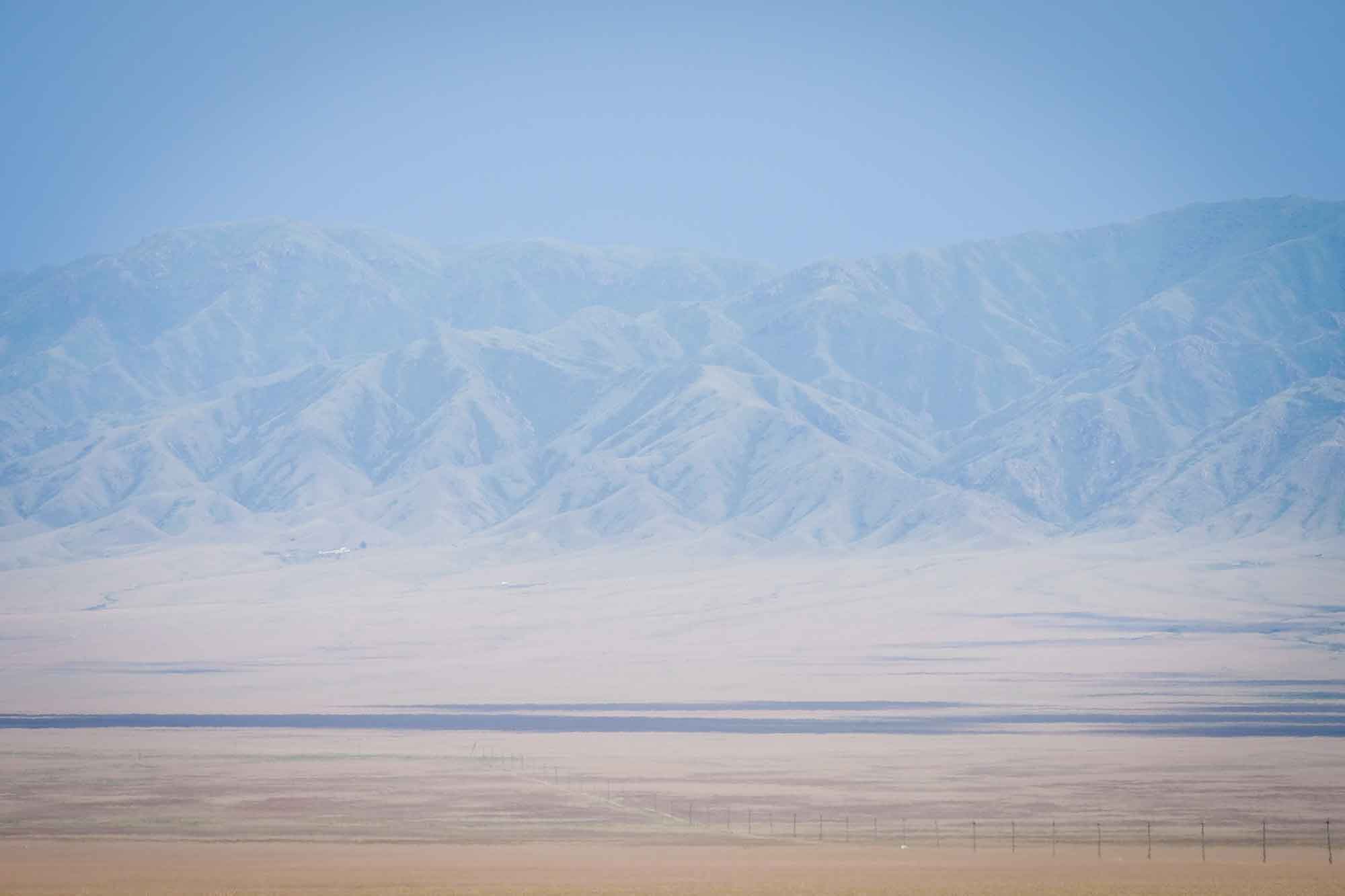
In the morning, I rode west out of Zharkent and took the lonely R-21 road south, skirting the small village of Koktal and crossing the slate-grey Ile River. In the bright sun and truncated shadows of midday, I rolled into the village of Tashkarasu. To the south, just beyond the railroad tracks, a bare biscuit-colored landscape opened, its soil scrubby and parched.
I sat in the shade, waiting for the town’s lone magazin to open. On the road before me an intermittent straggling succession of vehicles passed: ancient, boxy, and indestructible Lada sedans and wooden carts full of hay pulled by little grey donkeys. The mountains far to the south were a rumor in a thick whitish heat haze. A while later a man returned and opened up the shop, and I went inside and bought biscuits and pasta and tomato paste and onions and capsicum and chocolate and instant noodles. I packed them onto my bike and rolled south down the shadeless road, the air hot and still and oven-like on my skin except when the rare cooling breeze would blow.
I rode on until the shadows lengthened and the light ran like warm egg yolk over the world. In that evening glow, I pulled off into a field of dry spindly trees and sparse, dry, yellow grass and pitched my tent out of sight of the road, listening to the sound of trucks passing on the highway. As I lay there, the wind picked up, tossing and blowing, and though a few fat raindrops fell, the storm that they promised never finally arrived. I drowsed, my eyes closing of their own accord, and then slept, my dreams displaced and strange: I wandered through an empty shadowed city that I could barely see.
In the morning, I rolled into the town of Shonzhy and devoured a breakfast of eggs and bread and jam and tea at a roadside café, leaving nothing but a scattering of crumbs on the plastic tablecloth. Then I followed the A-352 highway west out of town as it turned into a rugged, hazy, depopulated desert landscape. At length the road dipped to bridge the silty Charyn River, and a short time later, I turned south off the highway onto a jeep track across the desert, tending in the direction of the local geological wonder known as Charyn Canyon.
Charyn was my first point of interest in Kazakhstan, and the starting point for what I hoped would be a new bikepacking route running from the Chinese border to Almaty, the country’s largest city. Route creation, however, was a tricky and unreliable business. You scoped these things out on a map, feeling pioneer-ish, but in practice, it always quickly became an exercise in map-territory disambiguation.
The previous day, for example, I’d spent some hours investigating a faint series of backcountry tracks running from near Tashkarasu almost to the entrance to Charyn Canyon … or so I thought. In practice, I’d waded rivers to sandy tracks that petered out in overgrown bush, and at one point was dunked to my nipples in a deep and swiftly flowing irrigation channel that looked like an advertisement for Good Places to Drown Magazine. I had wisely retreated back to the highway.
Thusly, I regarded my new track across the desert to Charyn Canyon with some wariness. A short way down the track, though, I came upon two Polish boys on bikes. Like me, they were sweating buckets, and, also like me, they were being utterly tenderized by the Olympic-level corrugations of which the track consisted. One had a long blond ponytail and a scabbed nose bright with peeling atomic sunburn. He rode a cheap kid’s mountain bike with 24-inch wheels that he had bought in a bazaar over the border in Kyrgyzstan. He was not at all child-sized and sat on the bike like an NBA power forward atop a Shetland pony.
He and his friend were like grotesques encountered on the plain in some strangely bicycle-focused Cormac McCarthy novel. They were maybe 21 years old and piloting kit that was barely seaworthy, their bicycles audibly creaking and their luggage consisting of ripped plastic shopping bags lashed to the handlebars with bungies. Big heavy salt-rimed packs stuffed to the gills were strapped to their sweating backs.
“This shitty road,” one said to me, indicating the washboard surface. I just beamed at them. Their bikes had likely cost less than my tires, and they looked like they were having a terrible time. I immediately loved them. These guys didn’t give a fuck about “bikepacking.” They weren’t having a “rad” time. No one was the least bit stoked. I high-fived them and told them to keep doing what they were doing, and though I think my enthusiasm was perhaps startling to them, they accepted it in stride — just another freak like them in the freak kingdom, out there on the road at large.
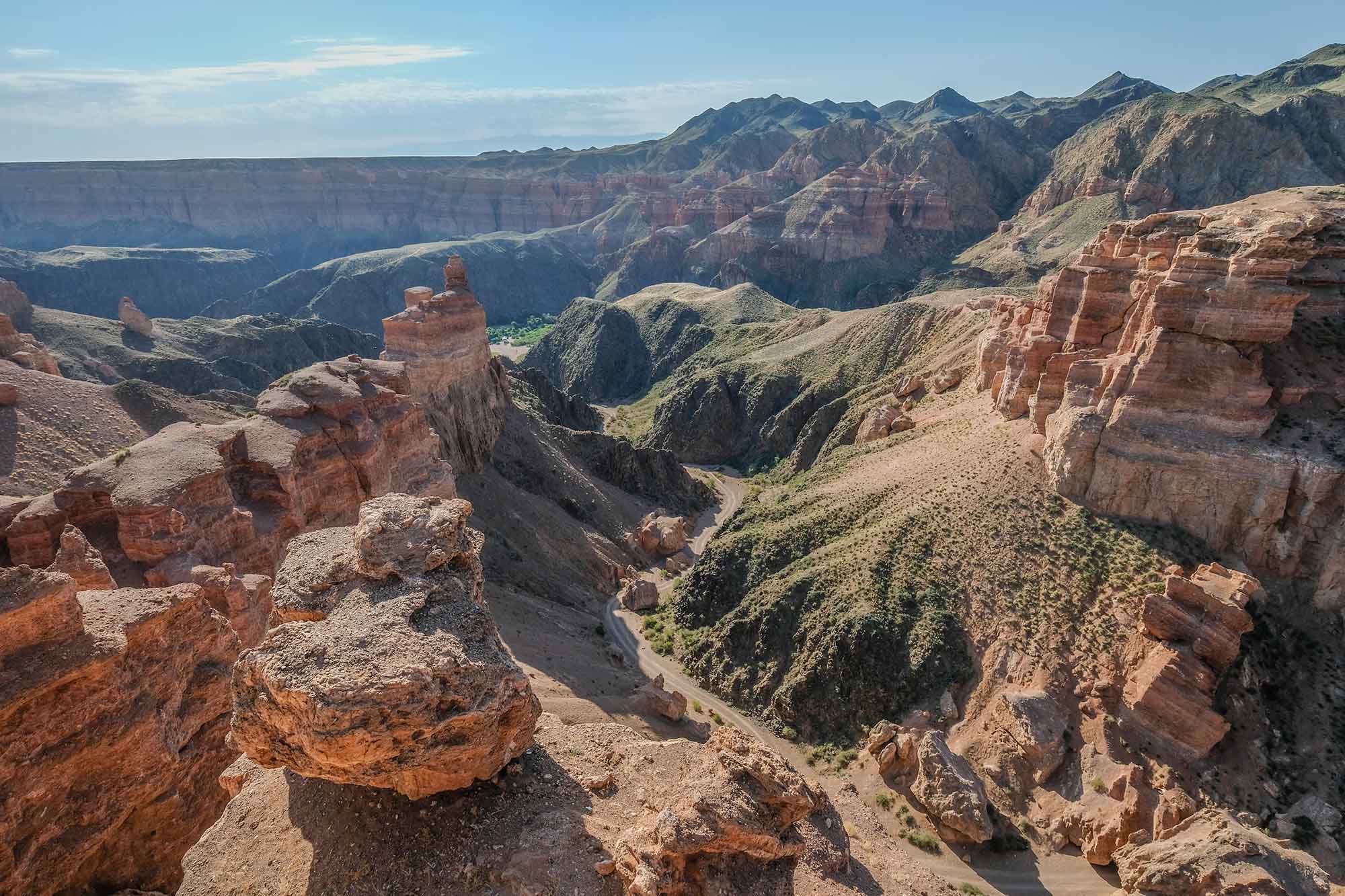
An hour or so later, I reached the entrance to the Valley of Castles. This was the most famous section of the multiple canyons that collectively made up Kazakhstan’s Charyn Canyon. The road in was an ultra-steep rutted defile that pitched me off my bicycle as I attempted to descend it. Just as I reached the bottom, however, a magnificent thing appeared: a battered old UAZ-452, the boxy off-road van colloquially known as the Buhanka or “bread loaf.” It clawed its way up the piste past me, engine rumblingly sub-sonically in 4WD-low. The van had the heart of a bear and all the ugly utilitarian beauty of Soviet command economics, and I was immediately and completely in love.
After scouting the canyon, I hid the bike up a dry wash behind some boulders and then spent the day exploring. I clambered over rocks and scrambled up the spires and red-rock chimneys that towered in fantastical wind-eroded formations high above me. Running just four kilometers before dead-ending into the rushing blue-grey waters of the Charyn River itself, the Valley of Castles might not be able to match the Grand Canyon for vastness, but it punched far above its weight in jaw-dropping natural beauty. I was happy and alive, right down to my marrow, and wanted nothing more.
I eventually set up a bivouac in the shade of a towering, house-sized boulder, then spent the last hour before sunset taking endless photographs, the cliffs incandescent as a kiln in that light. That night as I camped, the stars were bright cold chips of lucent ice above me, framed in cameo by the canyon walls; and when I woke in the dawn, it was to old Sol casting its bloodred glow on the face of the vermillion cliffs above like some prodigious heralding. I rose and climbed the steep canyon walls all the way to the rim above, watching the sunrise strike dramatic shadows in the deep valley below me. My heart pulsed within me like a wild creature habitant inside my human form.
After all the shit of Xinjiang — after the alienation and stress of China generally, against which I’d hardened myself in defense — to be here felt like melting, or like waking after a long sleep. It was not something that I had expected.
I felt unknotted, as if some bind in the warp of things had been secretly undone. As if this unknotting, somehow, was a lesson. I spent hours exploring the canyon rim until the sun was high in the sky, then scrambled back down to the canyon floor. I picked up the bike and, hoisting it upon my shoulder, hauled it up a long set of steps to the rim, where I rode off in the direction of Bartogai Lake.