Adventure Cycling’s Golden October Celebration Inspires Reflections on Past and Present

This guest blog post was written by Peter Simonson, a retired University of Colorado Boulder communications professor specializing in rhetoric, media, and the history of communication. Simonson is currently researching the early history of Bikecentennial and was inspired by our Golden October Celebration to reflect on what lessons 1976 might teach us today.
Could the ways that we bike make our troubled world a better, more humane place?
That’s a question I turned over as I drove 900 miles back from the celebration marking the 50-year anniversary of Bikecentennial 76 and the founding of the Adventure Cycling Association. It was a remarkable reunion of people who helped put bicycle touring on both the proverbial and literal maps in the United States. The experience left me thinking there might be lessons from that earlier moment that could guide our own biking adventures.
The story of Bikecentennial has been told many times — in articles, on podcasts, and through five decades of stories recounted by the participants themselves. As one rider at the reunion, Woody Wheeler, recently wrote, it was “an extraordinary adventure that, for many of us, remains a defining experience of our lives.” I wasn’t part of that experience, but over the last couple years, I’ve been doing research about it, talking with the organizers and riders, and learning what it meant to small towns the event passed through.
If you don’t know much about Bikecentennial, you’re not alone, so here are some basics. It was a two-wheeled celebration of the United States’s 200th birthday. More than 4,000 riders (around 10 percent of whom visited from foreign countries) rode all or part of the newly created TransAmerica Bicycle Trail, the nation’s first dedicated transcontinental bike route. That trail was created by Lys Burden, one of four cofounders of the organization later renamed Adventure Cycling.
When Lys planned the route in 1973, the nation was experiencing multiple crises that continue to this day: environmental degradation, social division, an unpopular war, skyrocketing oil prices, and a loss of faith in public institutions. In laying out the trail, Lys wanted to highlight the country’s varied physical beauty, its natural and human history, and its rural backroads. With the country’s public life in shambles, the TransAm would feature what the organizers considered the “real America,” providing the basis for a kind of pedal-powered renewal that would bring different kinds of people together face-to-face. It was an authentic, grassroots event with broad popular support across the political spectrum — exactly the kind of thing that didn’t happen during this past summer’s 250th.
The idea was hatched during the epic quest known as the Hemistour — a ride from Alaska to Argentina planned by four twenty-somethings who came out of the youth hosteling community in Columbus, Ohio. June and Greg Siple completed the entire ride, with June becoming the first woman ever to do so. Lys and Dan Burden were forced to cut their tour short in Mexico when Dan contracted hepatitis. Bikecentennial was originally Greg’s idea, with June naming it and the two couples brainstorming its details together, as June has detailed. While the Siples completed Hemistour, the Burdens headed to Missoula to spearhead the incredible logistics such an event would require. In terms of riders and total miles ridden, it would become the largest and arguably most important cycling event in the country’s history.
Sixty-seven original Bikecentennial riders attended the 50th gathering last month. They included Gijsbert Valstar, who almost single-handedly organized a contingent of 200 Dutch riders. The youngest of the ’76ers are now in their mid-60s. Most are older, and many have passed away. In Missoula, it was poignant to see their young faces in slides of the gorgeous photos, mostly taken by Dan Burden. Those images have done so much to shape the collective memory of Bikecentennial, and I heard many people thank the Burdens and the Siples for changing their lives. It was quite moving.
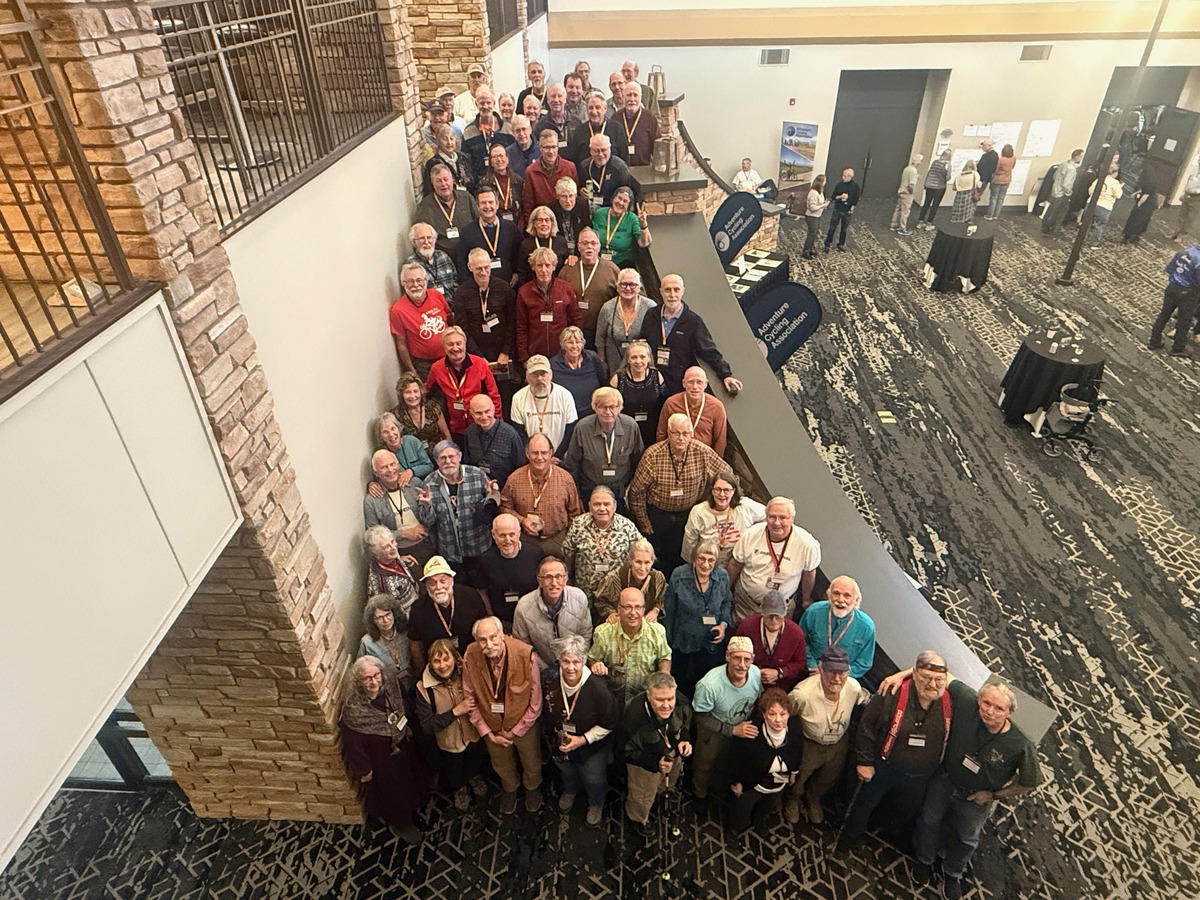
But what might those of us who weren’t there learn from Bikecentennial? I’ll share my four takeaways, which stem from one emblematic detail I heard at the event: Among the Dutch riders were several women who crossed the country on three-speed bicycles.

The first takeaway has to do with gear. The US bike boom of the early 1970s, which saw bicycles outsell cars for three years running, brought millions of adults into what had been mostly a children’s pastime. While there were some nice bikes and a little bit of specialized equipment available in 1976, cycling gear has developed exponentially since then. In some ways, bicycles have become one more consumerist pursuit in our consumerist society.
Don’t get me wrong. I, too, like nice bikes and gear, but cycling equipment has become fetishized in our society, where newer is often equated with better. Thinking of those Dutch women on their three-speeds climbing the Rockies and traversing the Ozarks can short-circuit that belief.
The second theme is bicycling as a way of life. Even though Holland is famously flat, those Dutch women could pedal up mountains because they rode every day in every kind of weather. In that era, bicycle advocates like Gijsbert Valstar, then a university student, were fighting to make sure highways weren’t built through Dutch cities, and as a result, the Netherlands became the cycling paradise it is today.
Today, I worry that touring and spandex-clad cyclists focused on setting their next personal best have become disconnected from everyday cycling for transportation. Bikecentennial arose in a moment when the trailblazing environmental group Friends of the Earth advocated for Americans to use their bicycles for trips of five miles or less. That’s still excellent advice — good for both our health and our straining planet. After Bikecentennial, the Siples spent years living without a car, and the Burdens promoted bikeable, walkable cities. That continuum between long-distance touring and everyday cycling was part of the spirit that drove the bike boom of the 1970s and, by extension, Bikecentennial. It was part ecological, part health and fitness, part countercultural.
Like the fetishization of gear, flying to exotic locales for our bike adventures is a mixed bag. It’s great fun and often personally transformative. And it is part of a collective way of life that has created our climate crisis. We need to look at our cycling pursuits with both eyes open. Those of us who tour, bikepack, or mostly do spandex riding need to reclaim biking as a way of life.
The third larger takeaway concerns who is in the saddle and how inclusive our cycling community is. Women comprised a third of coast-to-coast Bikecentennial riders and half of those on shorter tours. This represented an upsurge from the mid-1960s, when June Siple and Lys Burden were among the first female long-distance riders in Columbus. They were trailblazers. The logo Greg Siple designed for Hemistour in 1968 blended the meridians of a globe, spokes of a wheel, and the symbols for female and male. Bikecentennial was fed by this egalitarian, inclusive spirit.

That inclusiveness had limits. Bikecentennial riders were disproportionately young, educated white men from the middle and professional classes. There were four Black riders, which was two more than the number of one-legged riders. One of the four riders, Walter Johnson, who has continued to ride into his 90s, was apprehensive about crossing the plains due to the prejudice he anticipated. As he recounted in an interview with Adventure Cycling, he told himself, If I’m going to die, I’m going to die doing what I enjoy. He would make lasting friendships with members of his group, but his concerns reflected a larger reality. American cycling has long been tied up with American racism, intentional or ambient. That continues in contemporary bicycle advocacy and planning.
The open road is often an easier place for straight white guys like myself. I’m grateful for the work that Radical Adventure Riders and All Bodies on Bikes are doing to make the road a more hospitable place for everyone.
That leads to the fourth and final storyline, which concerns the ways that the individual freedom inherent in cycling also creates meaningful bonds, as they did for Walter Johnson. This seems to have been true for many, if not most, of the ’76ers, some 80 percent of whom rode in 12- to 14-person groups. Many of those cyclists have stayed in contact for 50 years. I heard one woman describe their bonds as a kind of “deep, platonic love” that grew from sharing a common goal.
There were also cross-cultural interactions between young, often long-haired riders from the coasts and rural folk. “Connecting with strangers gave me hope in the inherent good of people,” rider Patti Brehler told me.

Touring exposes us to breathtaking beauty, challenges our mental and physical wherewithal, and takes us far outside our routines. But at its best, it’s also a way to be reshaped by others, whether those encounters are sustained or fleeting. It’s essential that we don’t let that element of human communication get lost in the mix.
It’s a truism to say our country is divided. So, as we bike through regions where there aren’t a lot of cyclists, we are visitors in other people’s worlds and representatives of the greater cycling tribe. How are we presenting ourselves?
In the summer of 1976, a Mennonite newspaper in Kansas praised the Bikecentennial riders as “practitioners of the simple life” and recognized shared values that might not have been obvious to some observers. We have opportunities to do similar things in our own travels. In small ways and large, how we bike can create the world that we’d like to bring into being.