Pondering Bike Touring’s Past, Present, and Future from a Penny-farthing Saddle

Have you ever wondered what cycling will be like in 50 years? What about 50 years ago? These were questions I pondered over the 13 days it took me and five other riders to replicate a bike tour our club did in 1976: 750-plus miles from Dearborn, Michigan, to Philadelphia, Pennsylvania. But while the rides themselves were spaced 50 years apart, the bicycles were not — antique bikes from the 1880s were used each time.
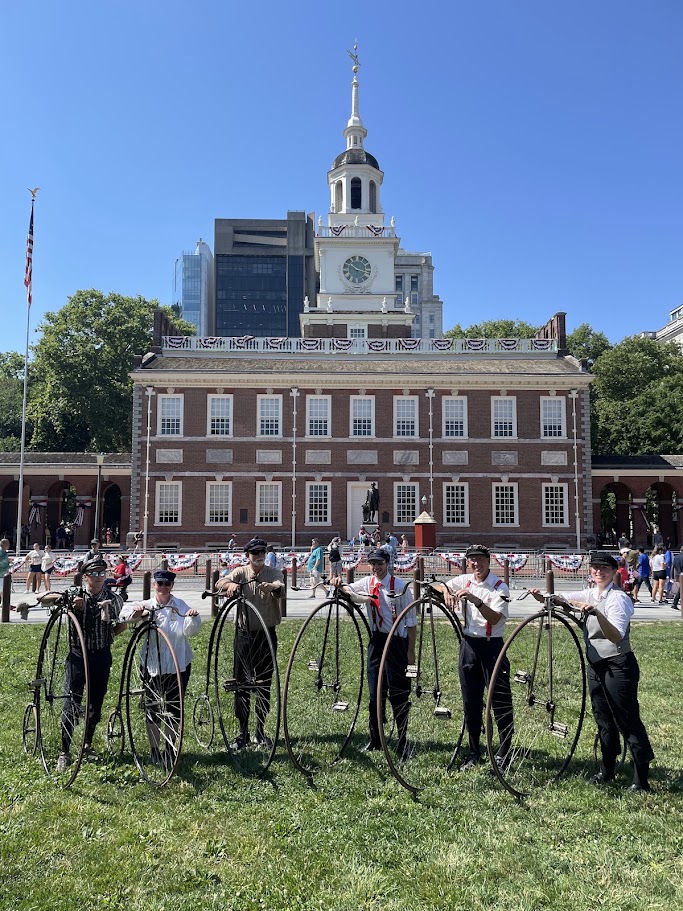
Our club, The Wheelmen, is a “national organization dedicated to keeping alive the heritage of American cycling, promoting the restoration and riding of early bicycles manufactured in and before 1932.” The most famous of those is the high wheel bicycle, also known as an “ordinary” or a penny farthing. Around 1973, a few key Wheelmen members began planning a trip to Independence Hall in Philadelphia for America’s bicentennial. The starting point? The replica Independence Hall at Greenfield Village in Dearborn. Just a month ago, I finished this ride myself for the 250th birthday of the United States. We named our trip The Golden Jubilee Tour.
When we met on the morning of June 21 in our traditional club uniforms to start the tour, we were joined by a few members of the original ride. While none would join us for this jaunt across the Midwest, I was still filled with questions. Most specifically, “How on earth did they do it in the ’70s?” Even in the article from the club’s magazine that chronicles the first trip, there is very little documented about the full preparation that took place over two years, which included making custom “turn here” signs and driving the full route.
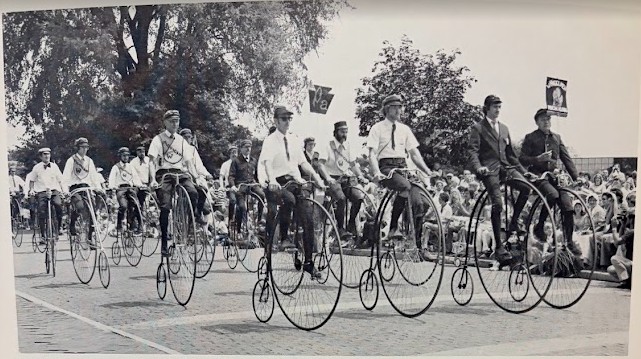
I was able to sit down with two of them, Alan Otter and Butch Porath, to find out the answer. There were some similarities that were to be expected: A few key people planned the trip, and the other riders came along for, well, the ride. The planning methods, of course, could not be more different. The 1976 Wheelmen created a whole administration to support their tour, complete with pre-trip coordinators, a parade captain, and hospitality and meal coordinators, just to name a few roles. We did have an excellent pre-trip coordination team, but our meal coordinator was me on the Yelp app.
Other apps were discussed so we could chart the best paths, though our goal was to match the main stopping points from 1976. We had no custom signposts, but our SAG wagons sat at critical turning points. Today’s packing list consisted of electrolyte powders, numbing gel, bike shorts, jerseys, and power banks for our phones. Cut-off jean shorts and T-shirts were the outfits of choice in 1976, and nary a helmet or a pair of bike gloves was to be seen. Even water bottles were rare. Alan shared a story about nearly roasting to death in Pennsylvania before a SAG rolled up carrying drinks. After that, he and his wife, Linda, each taped a water bottle on their bikes.
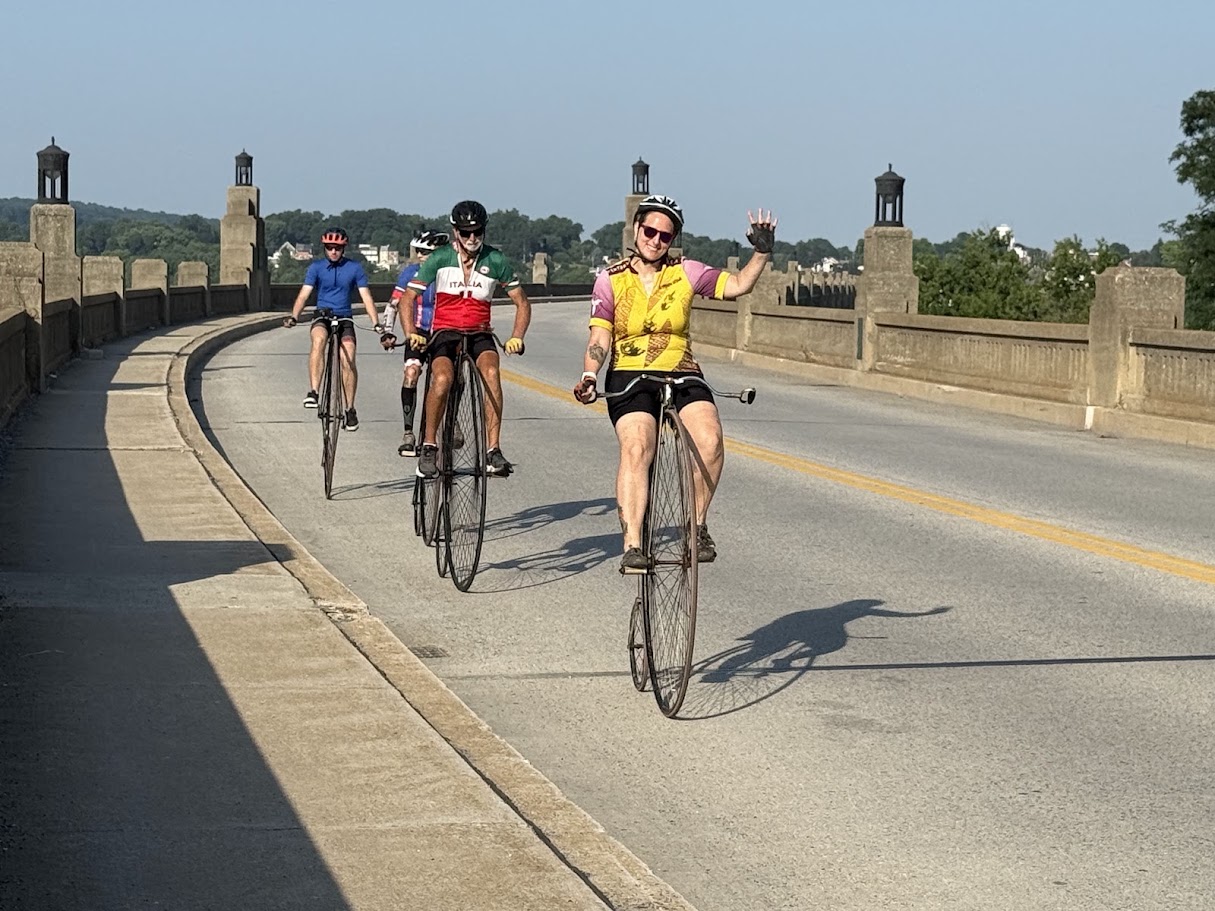
With Google Maps as our guide, my companions and I were completely in technology’s hands as we traversed the states. The ’70s committee charted its own course and broke it down into a 15-day trip, writing out daily directions and circulating copies to the riders. While my group lamented not having paper maps, Google Maps was able to redirect us as necessary around terrible dirt roads or accidents.
My first question when interviewing Butch and Alan was, “You had no cell phone. How did you all stay in touch with each other?” Simple. To make sure no one got lost, one of the planners drove the day’s route as a sweeper to ensure everyone made it to the checkpoint. There was a moment when a rider accidentally got onto a highway, but they were pointed in the right direction by highway patrol.
While smaller in number, our group of six had some things in common with our predecessors. We had young riders (16 years old) and seasoned riders (our oldest just turned 70). On both rides, there were folks from across the United States who joined, and each time there was even someone who flew in from outside the Lower 48. In 1976, there was a man from England, and in 2026, we had a rider from Puerto Rico.
There were plenty of differences besides the group size, too. One of the biggest was how many families came for the full trip in ’76. Moms with kids in tow drove SAG wagons, pitched campsites, and prepared food. Butch’s wife, Denise, was one such superhero. But while there were no toddlers in our group, it still was a family experience. We had a father-son, husband-wife, and father-daughter (me!), and my mother came to SAG for several days. Speaking of which, our group had only two SAG wagons with us full-time. The ’70s crew had a dozen.
We slept in hotels and a campsite with cabins each night. Our predecessors camped almost exclusively in parks, school parking lots, or a random field. The camping was made possible with each town’s support, and this was also how they got dinner each night. One of the main coordinators, Gary Woodward, let each town know about the adventure, and he negotiated a place to stay and a potluck dinner at these night stops. In return, the riders did a bicycle demonstration for the town in whatever parking lot was available. In contrast, I used Yelp to find restaurants to eat dinner, after which the trip planners would spend about an hour solidifying the next day’s route before getting our rest.
My favorite and most surprising similarity, however, had to do with treasure. As our bikes go 10 to 13 miles per hour on average, and we had to be hyper-aware of any obstacles, we spent an enormous amount of time staring at the street. This gave us plenty of opportunity to notice our immediate surroundings. With that in mind, I created two bingo boards for our group, one for unusual trash and one for wild animals. It got the group invested in spotting as many Fireball whiskey bottles as we could. (We did not pick them up.) My dad and I also collected those black bungee cords that come off semi-trucks.
It turns out that this magpie-like search for trinkets runs in the Wheelmen. One member of the ’70s group collected beer cans, and Alan’s biggest regret was not stopping to pick up a horseshoe he spotted in Amish country.
In 50 more years, maybe flying cars will finally be a reality, and we cyclists won’t have to worry about traffic. Maybe robots will even drive our SAG wagons and prepare snacks. But no matter what the future brings, I have a feeling that, even then, we’ll still hold the same time-tested values dear: enjoying the ride, camaraderie with others, and looking for treasures along the way.
Visit highwheelride.wordpress.com for the full story on the 2026 Golden Jubilee Tour.