Why a “Slow” Bikepacking Film About the Midwest Struck a Chord on YouTube

Leigh Foster never says a word in his short film The Perfect Midwest Bikepacking Route. Across 572 miles from Chicago to his childhood home in St. Paul, Minnesota, he appears mostly as a figure pedaling through the frame, inviting the audience to see the country as if they were beside him.
The Chicago-based filmmaker has built a modest following chronicling his bicycle tours in iconic tourist destinations such as Costa Rica and California. But his most successful project by far is set closer to home. The Perfect Midwest Bikepacking Route, released this past summer, focuses on a region whose scenery is frequently written off as flat and uneventful, and its 160,000 views owe a great deal to that humble location. Now he hopes to repeat that success with The Best Riding in the Midwest Is Hiding in Wisconsin, another ode to the Midwest released earlier this month.

His love for his home region is obvious in both films, where the camera stops for ordinary moments, each held in a steady, patient frame: horses trotting in a paddock, wind moving through the trees, an insect clinging to an unopened flower, a child in a pink sweatsuit stepping carefully along a sidewalk.
“A lot of people in the comments seem to be responding to how I present the Midwest in a way that doesn’t often get shown,” Foster said. “Honestly, I was just showing the Midwest the way I see it, which is as a beautiful and amazing place to ride a bicycle. There wasn’t a single piece of it that I didn’t truly enjoy.”
Foster credits some of the response to his own growth as a filmmaker, which he says has accelerated over his past few rides. As a trained photographer, he has mostly relied on carefully composed shots rather than elaborate camera work, and he lets on-screen text and ambient sound carry the story. “I think there’s an appetite for slower, analog, experiential media,” Foster said. “I’m never going to make your heart rate jump through the roof.”
But one of the most significant additions he made in The Perfect Midwest Bikepacking Route was also one of the simplest: a map. His previous films never showed viewers where he was on his journey, an omission he came to see as a mistake. “Bikepackers, they want to know where they are,” he said. “They want to see maps. They want to understand the logistics.”
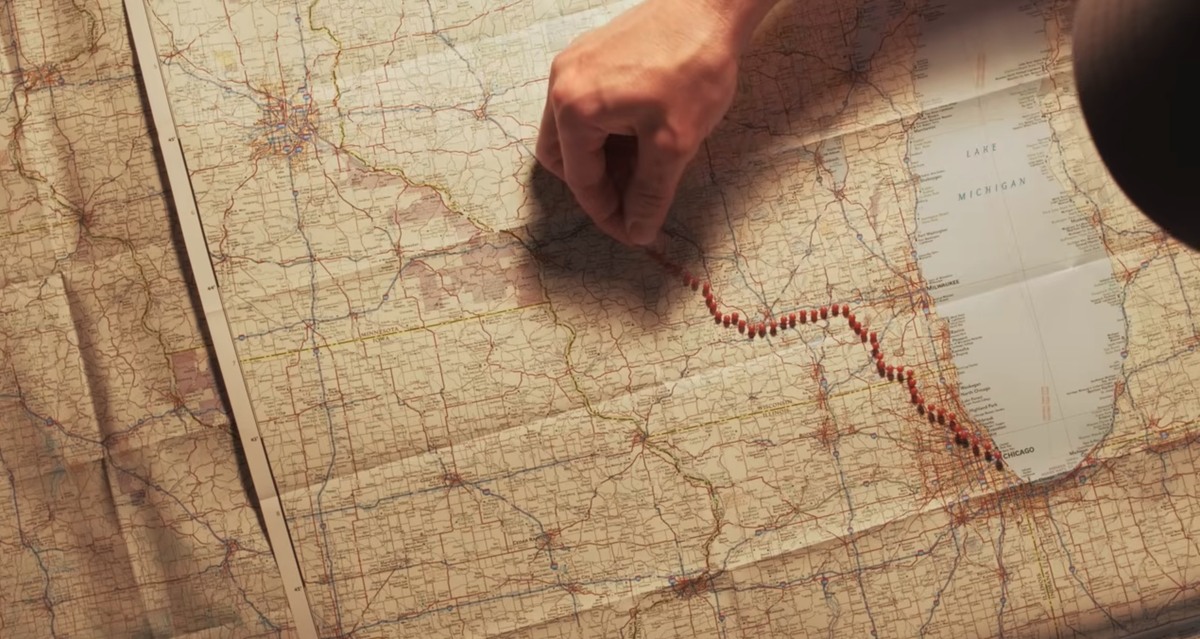
Unsure how to animate his route, he chose an appropriately low-tech fix and pressed red pins into a paper map to mark his progress. It also showcases his hands, the part of him with the longest on-screen résumé. Off the bike, Foster is a working actor with credits on NBC’s lineup of Chicago-based dramas and a successful hand model. “My mom put herself through law school as a hand model,” Foster said, adding that his agent would be “appalled” to see his cuticles in such an unmanicured state.
Hands aside, The Perfect Midwest Bikepacking Route asks very little of its star. Over 16 minutes, Foster rides from his apartment in Chicago to his childhood home with barely a hint of conflict. It was a narrative approach his brother, a screenwriter in California, urged him to reconsider, suggesting he manufacture some drama, even a crash, to give the story momentum. Foster resisted. “I always tell him, ‘I’m just out here, literally just riding and filming what happens,’” he said. “If I try to manufacture a narrative on top of that, which I think a lot of people try to do, I don’t think it works very well.”
To illustrate the point, Foster described a video he had recently watched of a couple riding across the desert. Early on, they established a looming concern about their water supply and tracked their stock with water-bottle icons at the bottom of the screen to build suspense. But by the end, the supposed crisis never materialized and the icons simply disappeared. “That is so cheap,” Foster said. “They never ran out of water. They weren’t even really that close.”
Foster has done his share of rugged off-road riding, but he prefers a gentler pace that leaves room to look around. “You’re not killing yourself at any point,” he said. “You’re just slow and steady and peaceful. You’re looking around, and you’re daydreaming.”
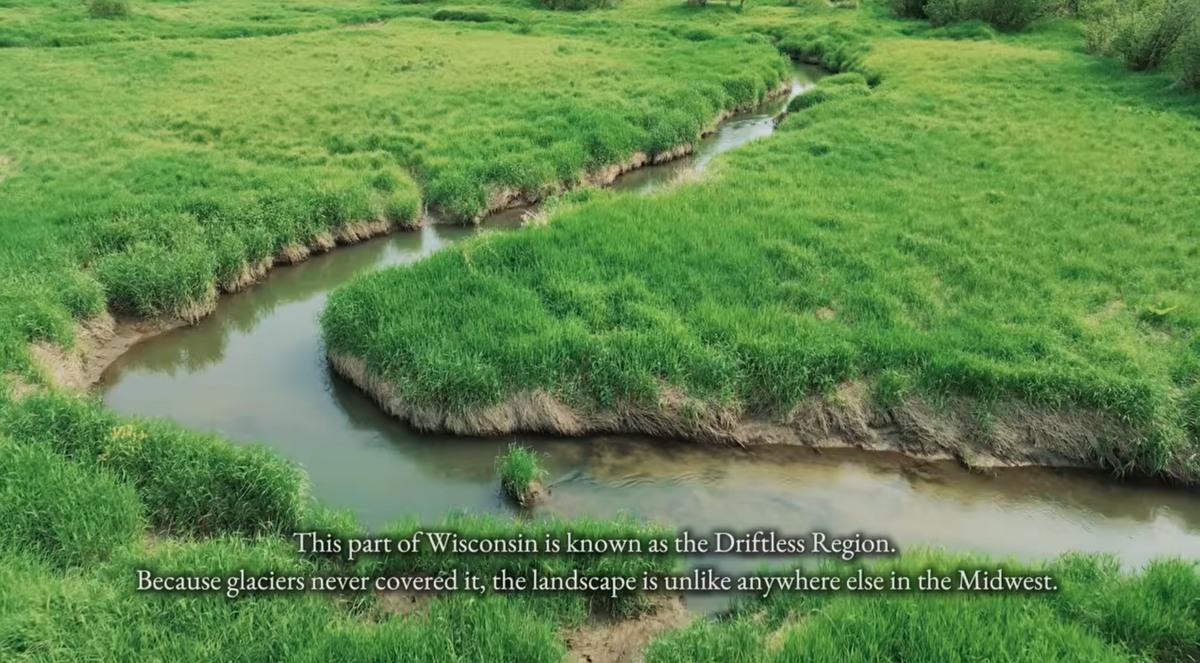
His films embody that ethos by swapping drama for scenery. The main character of The Perfect Midwest Bikepacking Route isn’t a person, Foster said. It’s the distance between Chicago and St. Paul, from the Des Plaines River Trail and the forests of Kettle Moraine to Devil’s Lake and the Driftless country of southeastern Minnesota.
When a potential composition catches his eye, he simply sets up the camera and rides through the frame. “I try not to do more than one take,” he said, noting that touring already feels like a full-time job, with miles to cover and rest stops and overnights to find each day. The one place he refuses to economize, however, is in deciding whether to pull over. He often notices something interesting only after he has passed it, when the easy choice would be to keep riding. “My rule is, I gotta stop,” he said, even if it means turning around a couple of blocks later.
Foster isn’t alone in his slow, drama-free approach. His short documentaries are part of a growing trend of travel videos focused on sights and sounds rather than conflict or adrenaline. On YouTube, for example, hours-long city walks filmed without commentary have become a popular form of armchair travel, which Far Out magazine has called a reaction against the attention-grabbing tricks of modern content.
As much as Foster values the Midwest’s slower pace now, he didn’t always see its appeal. Growing up in St. Paul, he took pride in being a city kid. “I wouldn’t even go into the suburbs,” he said, “and I was happy about the fact that I just didn’t know about these places because I never visited them.” That began to change years before the film when he undertook his first tour from Chicago to St. Paul. He had never heard of bikepacking and simply wanted to know whether he could ride a route he knew well by car.
By the time he reached his childhood home, he understood the stretch between the two cities in a way he hadn’t before. “It makes the connection to your home so much stronger,” Foster said. “You can’t really absorb that stuff from a car.”

He takes that idea one step further in this month’s The Best Riding in the Midwest Is Hiding in Wisconsin, while simultaneously making the biggest change to his style yet: dialog. Or more accurately, placid conversations with locals he meets along the way, whose quiet love for the land and their communities matches Foster’s own and enhances his storytelling rather than detracts from it.
Sometimes you don’t even need to see them to feel their presence. There is a brief scene in The Perfect Midwest Bikepacking Route that could be read as simple quiet contentment after a long day in the saddle. But there’s more behind Foster’s smile. As he tells it, he had reached the park to find the ground soaked and the ranger station closed, which meant no firewood for sale. With the campground nearly deserted, he checked one empty site after another for anything left behind. At the last one, he found a dry supply under the picnic table.
Then came a second surprise: a beer he had forgotten about, buried at the bottom of a pannier. It was the third time a stray can had turned up for him at just the right moment. “When you’re out there,” he said, “and you’re deprived of those things that you normally have access to, they become so much more meaningful.”