
Circumnavigating Iceland — Beyond the Ring Road

This article originally appeared in the 2024 Nov/Dec issue of Adventure Cyclist magazine.
The dark plume rose on the horizon as we trundled through the desiccated desert. An erupting volcano? Mists rising from a muddy waterfall? We couldn’t decide. But we couldn’t fathom any other options here in Iceland’s uninhabited interior. We’d soon know either way. Our route was taking us straight toward it, and it grew bigger, darker, and angrier with each pedal stroke. Were we scared? A little. Excited? Absolutely. Soon, we thought, we’ll marvel at yet another unfathomable natural phenomenon in this eclectic landscape.
The most gripping stories hinge on the stakes created by opposing forces, and the higher the stakes, the more riveting the tale. In that way, our journey through Iceland would unfold like a mystery novel with twists every few pages. The small, North Atlantic island nation is known as the Land of Fire and Ice due to its subarctic geography and the ongoing geological fury of its creation. That contrast breeds a landscape filled with spectacular discordance, and the plume on the horizon was one more in a long series of riddles that kept us on the edge of our seats — or more accurately, on the noses of our saddles.
ONE DOOR CLOSES
When my plans to compete in Ireland’s 2,500-kilometer TransAtlanticWay bikepacking race fell apart at the last minute, I was initially depressed. I’d trained, planned, and selected gear for a specific climate, distance, and terrain. But then I realized there was opportunity in that disappointment: the slate was clean. Despite its northern latitude, Iceland has a remarkably similar climate and terrain to the Emerald Isle, so I quickly hatched a plan to circumnavigate the island on as many gravel tracks and dirt roads as possible to avoid its famed Ring Road.
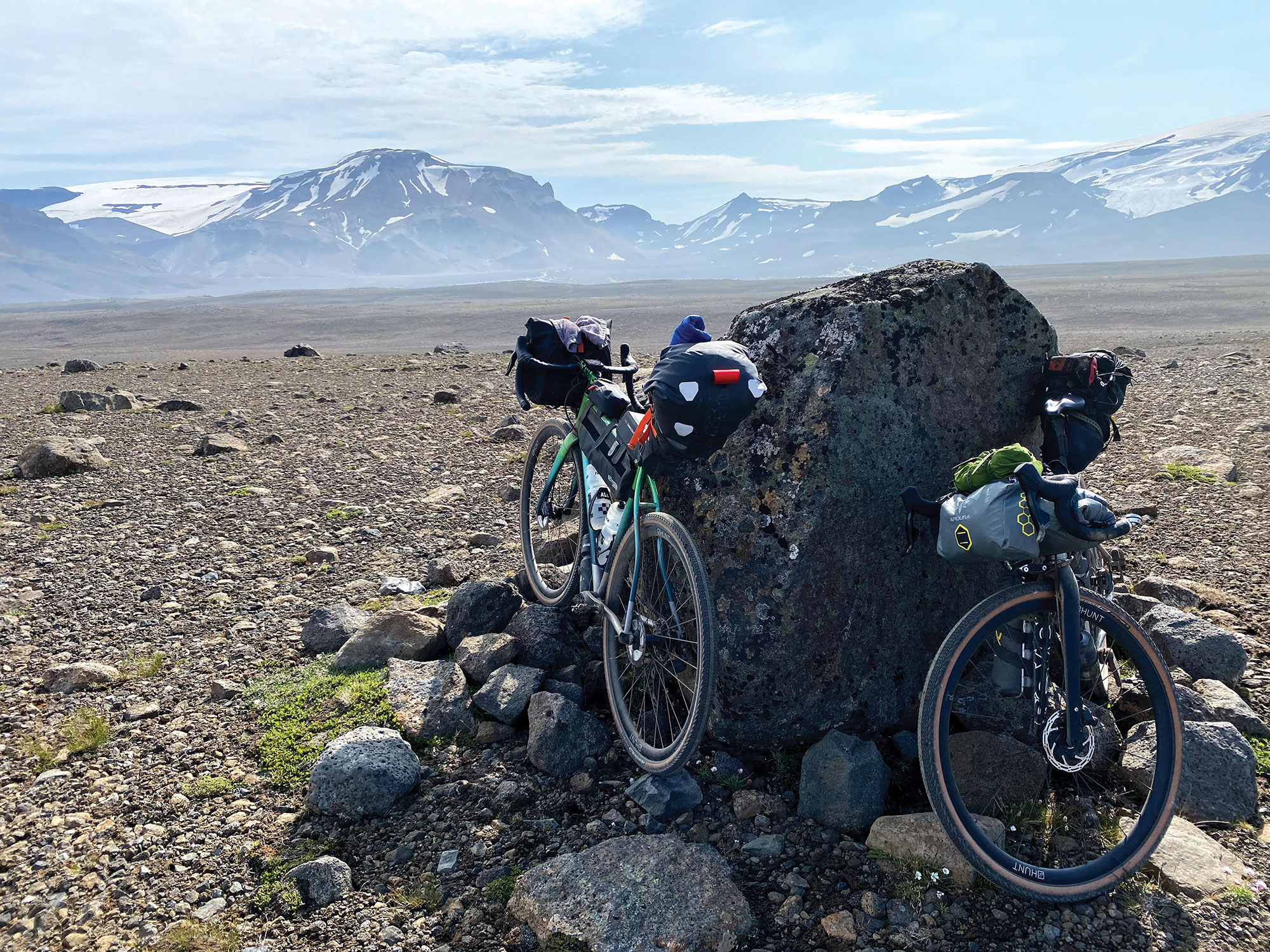
It’s not that the Ring Road isn’t worthy of its popularity. I just like dirt roads and big challenges. I don’t like to do what others have done, and I really don’t like cars. After researching possible paths online and scouring maps for telltale signs of interesting terrain, such as switchbacks and densely packed contour lines, I created a route we later dubbed Alt Ring Iceland. It hugged the island’s perimeter with a few forays into the interior, known as the Highlands.

Then I set out to find someone crazy and fit enough to join me. Although I had never met Matt Roy, I knew him by reputation through mutual cycling friends. He’d raced Paris-Brest-Paris, TransAtlanticWay, and countless ultra-cycling events. “Want to ride around Iceland with me in a couple weeks?” I texted without much hope that he’d be able to join on such short notice. “Um, yes?!?” he responded two minutes later, and after a few more texts flew between us, he booked a flight the next day.
Once we arrived in Iceland, we met near the oversized luggage drop. It was the first time we’d ever been face to face. Then we built our bikes in “the Pit,” a purpose-built bike shop for touring cyclists at the Keflavík airport, and headed straight into the fury. We planned for around 1,300 miles of rough riding. We had 13 days. We had to get moving.
RUDE AWAKENINGS
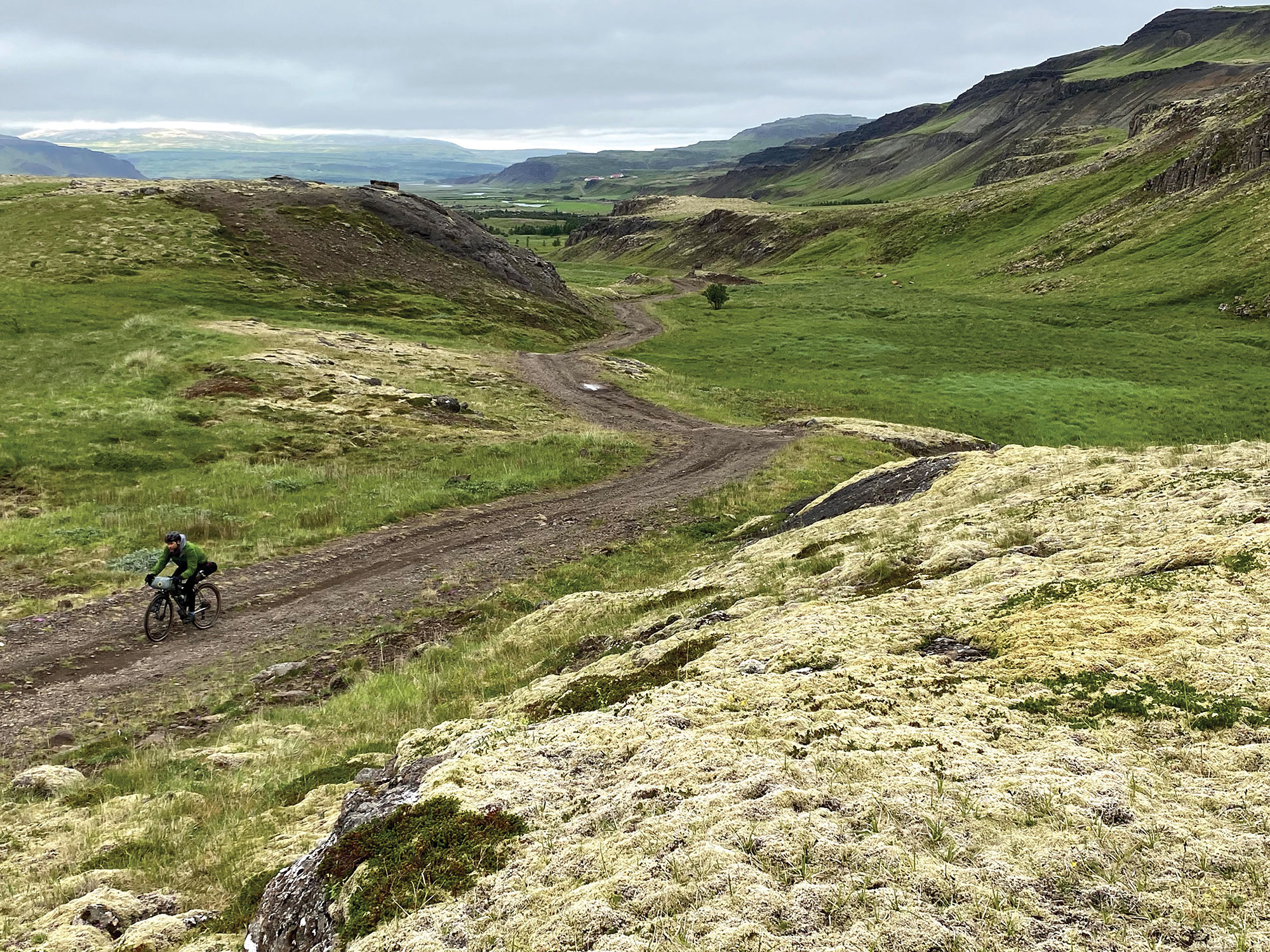
It didn’t take long to realize we were, quite literally, in unprecedented territory. Iceland isn’t like my home state of Colorado or Roy’s New England — or anywhere in the Lower 48 for that matter. The Southern Peninsula, where Keflavík International Airport sits, is home to the Reykjanes volcanic system, a seemingly endless lava field with faults and fissures, hillocks and hoodoos, some covered in mossy green growth, others raw and rough. In contrast, the Icelandic coastline was filled with life. We were immediately accompanied by soaring seabirds including curlews and Arctic terns, which floated along and kept us company on the lonelier stretches of road when they weren’t dive-bombing our heads.
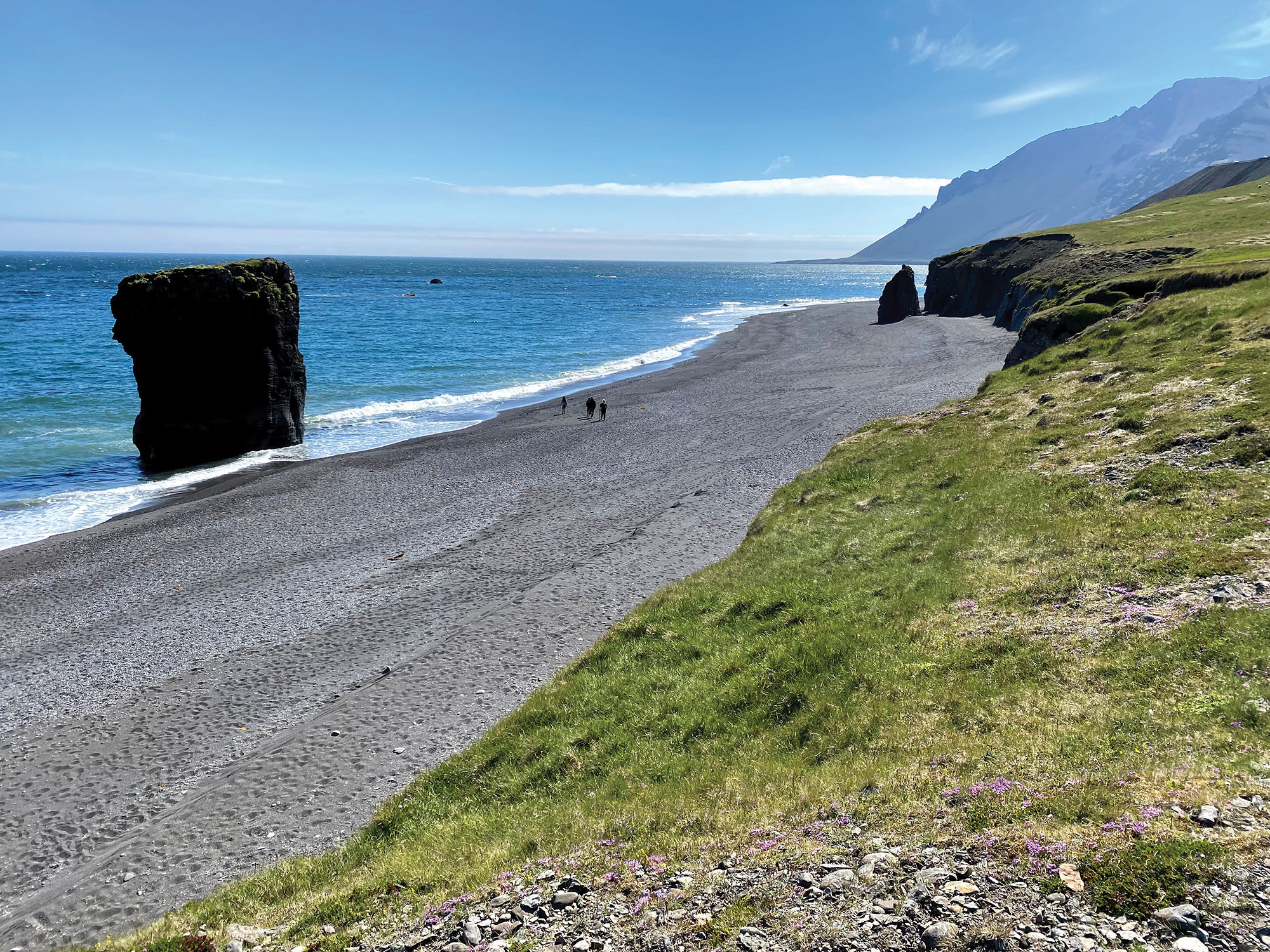
Despite the distances we hoped to cover each day, Matt and I wanted to wrap our arms around the beauty we were immersed in. So we made a pact: if either of us even thought about stopping to take a longer look, we’d slow down and get off our bikes, timetable be damned. If need be, we’d ride through the night so we could take it all in.
We also knew that no journey to Iceland would be complete without a jaunt into the uninhabited interior. The region might be stark, but it’s laced with hundreds of rivers, some of which rage and others that trickle. Many of the channels lacked bridge crossings, meaning we’d have to wade through their icy waters. Our first foray into the Highlands came on our second day when we climbed straight into the black sand desert known as the Mælifellssandur on a collection of increasingly rugged gravel tracks surrounded by the Mýrdalsjökull glacier, ancient volcanoes, and a whole lot of solitude.
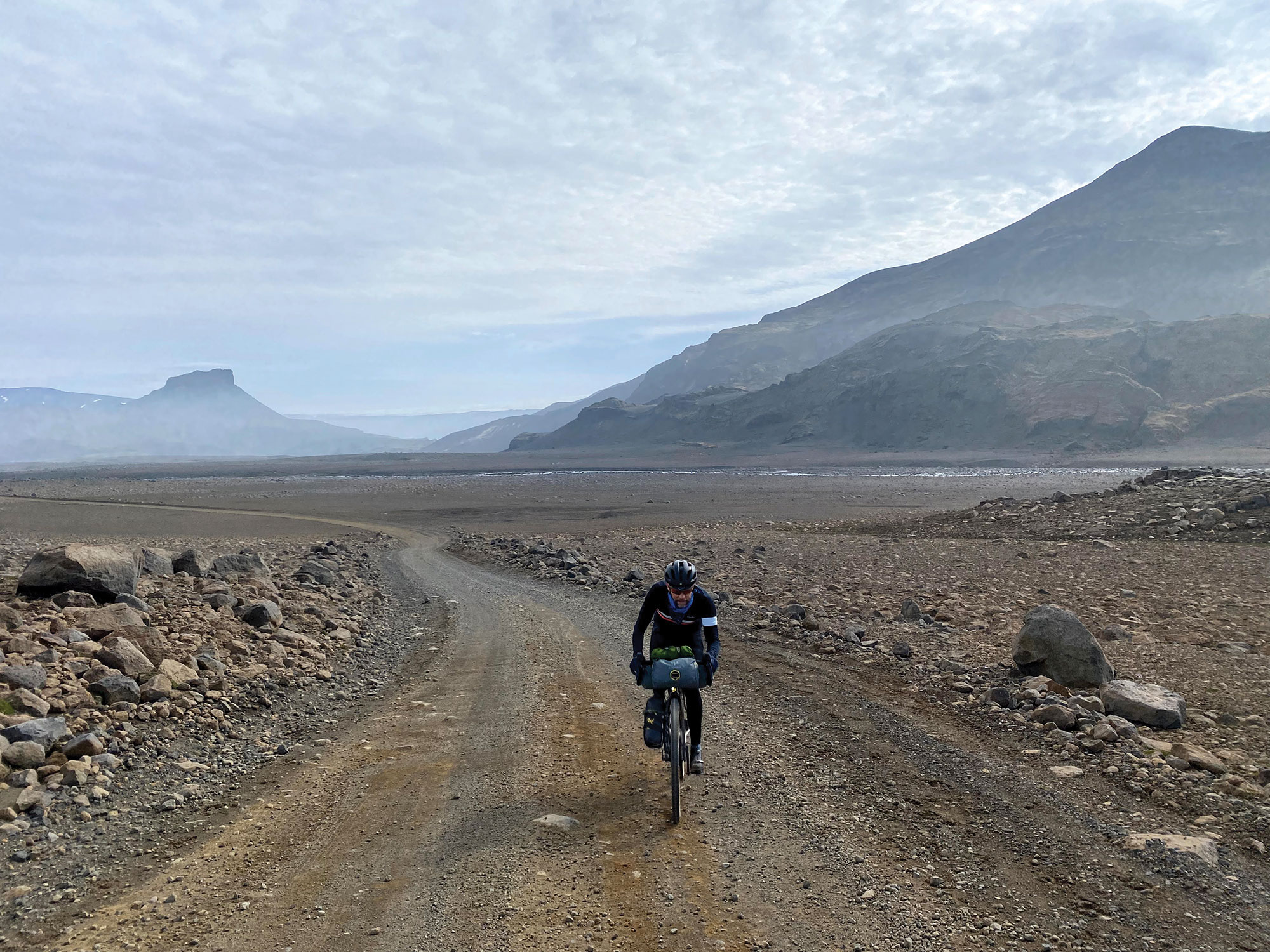
Occasionally, we’d pause, either to take in the vast landscape or to relocate the track among the rocks and rubble. While we weren’t aware of it at the time, this would prove to be one of the most eventful days of our trip. It was the day of the plume. We’d seen the dusty cloud in the distance for hours. Geyser, eruption, mists? We were perplexed and intrigued. Then, suddenly, we understood all too well what it was. The plume turned into a raging sandstorm. Fine black grit swept over us, ripping at our faces and piercing our eyes. Jerseys fully zipped and buffs tucked under our glasses, we forged on. There was no way out except to go in.
At the peak of the storm, visibility dropped to around 20 feet. A fresh layer of particles covered the already sandy double-track, and we struggled to ride. Then we struggled to walk. We would run and jump on our bikes to build up our momentum only to pedal a couple dozen feet before bogging down and coming to a halt yet again. Matt bent over, resting his head on his saddle. He seemed to be crumbling. For over an hour, we struggled to make forward progress.
When the winds dipped and I thought it safe enough to pull out my camera, I grabbed a few photos and videos of Matt grinding by. “What’s the word of the day, Matt?” I yelled through the din. A single word came to me on the howling winds. “Variety!” He smiled. His positivity and sense of humor given our circumstances gave me chills. Or was that the penetrating wind? Either way, this was what we were here for — to move beyond hardship to a place of kinship.
Then, suddenly, the storm was gone. I found myself cackling with laughter. I suppose there was a bit of fear, but mostly I was overjoyed to be alive and able to do what I love, to choose to do the absurd. Only after we made it out did we fully grasp what we’d just experienced: a landscape trying to consume us. Only after we made it out did we consider where we’d sleep that night.
Encrusted in grit and looking like 19th-century chimney sweeps, we sought a shower, a bar of soap, and an actual bed. For better or worse, Iceland has exquisite cellular coverage, so when we eventually reached an intersection of dirt roads, we whipped out our phones to find somewhere to stay. Glacier View Guesthouse was just two miles up a steep road. We looked at each other like a pair of knowing raccoons.
At around 9:00 pm, after 14 hours of riding through the most thrilling hellscape I’ve ever encountered, we gently knocked on the locked door. It swung open a moment later, and Elin half smiled.
“Hi. Apologies for our appearance, but do you happen to have any rooms for tonight?” Matt asked.
“Oh, a room. Let me see. One moment please.” Elin scrambled inside, unbothered by our startling appearance. We waited, staring at each other, hoping we wouldn’t have to crawl into a bivy sack looking like we’d just fallen into a black glitter factory.
Elin returned, but she had bad news. They were out of soup. But if we didn’t mind waiting a few minutes, she could arrange a room for us. She just had to make a quick call first. Her friends planned to stay the night, and she needed to let them know they’d have to sleep in the staff quarters instead. The staff would spend the night in a tent in the yard. “Oh, and you will have to eat dinner with my friends,” she said. “And it will be a seven-course meal. I hope that’s okay?”
This is when I fell in love with you, Iceland. (And you, Elin.)
FIRE AND ICE, GRAVEL AND GRASS
To understand the beauty of this island below the Arctic Circle, it helps to know its geology. Iceland is split by the Eurasian and North American tectonic plates, which are moving away from one another at a rate of two centimeters per year. And like Hawaii and Yellowstone National Park, the country sits atop a volcanic hotspot. The Iceland plume, as it is called (not to be confused with our sandstorm), is believed to have created the island some 16 million to 18 million years ago. The result is frequent volcanic activity and rampant geothermal phenomena that make the land feel like a living thing. Fizzing, hissing, misting — it’s nature’s way of giving birth.
The island isn’t lush, of course, but it isn’t all bleak volcanoes, either. There are pockets of incongruous color everywhere, including electric green where thermal vents sustain grasses, mosses, and lichens. In Krýsuvík, pure sulfur paints the landscape yellow, and reds and browns abound from iron and sulfur amalgams, which oxidize like old anchors. A hundred shades of gray materialize as sulfuric acid dissolves basaltic rock. Meanwhile, silica, calcium, and gypsum punctuate the pores of the alien landscape.
With the right bike and gear, an adventurous spirit, and a sense of humor, you can cycle through it all. Just beware of giving yourself whiplash as you crane your neck to comprehend how a lush mountainscape could be surrounded on four sides by a barren expanse. Not only will you fail to predict what’s around the next corner, it’ll likely be something you didn’t know existed.
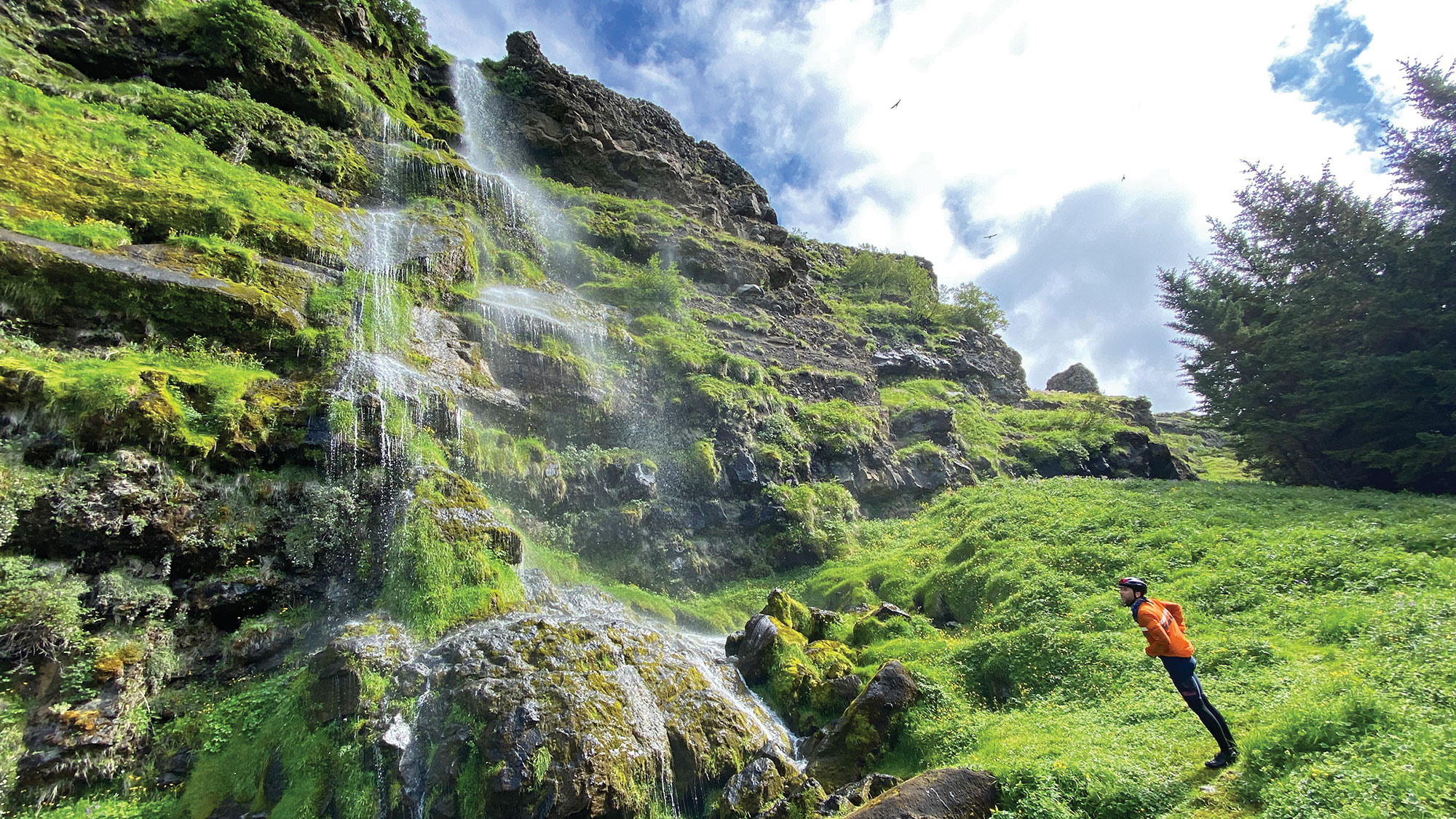
If there is one constant, however, it is the wind, which has a certain strength and determination. You might even call it relentless. That’s not to say there aren’t calm days, but they’re infrequent. When the wind does blow, it’s usually in your face, it’s usually lively, and it usually sticks around for a good while. Once, after finding a giant dumpster in the middle of nowhere, we took the opportunity to shelter in its lee to experience still air for a few minutes. Instead of intimidating, we found this invigorating. We came to this country to feel alive, to embrace the sea breezes as they envelop us with their salty sweetness.
You might think that these winds and the harsh climate are why there are so few trees in this land. Not true. When seafaring Vikings sailed from Norway and colonized Iceland in the late ninth century, forests of mostly birch trees covered more than a quarter of the island. Within a century, however, the settlers had razed nearly all of the original forests to build houses and clear land for grazing. Now, Iceland is considered the least-forested country in Europe. As the locals joke, woodlands are so rare and their trees so young that if you get lost in one of them, all you have to do to find your way out is stand up. This leads to incredible, unbroken vistas for sightseeing, but it also makes the miles go by slower if you’re grinding away in an unrelenting headwind.
The lack of trees also means there isn’t much vegetation to protect the soil from eroding, which has led to the vast deserts across the interior Highlands. In fact, NASA and other space agencies take advantage of that lunar-esque landscape to test equipment and procedures. The country’s latitude also contributes to its otherworldliness. Sitting so close to the Arctic Circle, its summers are filled with continual daylight, meaning you can easily ride late into the night.
The long days come with dangers, too. Without the traditional cue of sunset, you easily forget the time, which can lead to missed dinners in town. And when you end up in Vopnafj örður, population 560, at 10:00 pm, the only source of sustenance is the local gas station, whose offerings are no better than what you’d find in the U.S.
We strolled up and down the short aisles, but the salty snacks and candy bars we eyed would make a viciously unsatisfying meal. After pacing back and forth, I finally broke down. Calories out, calories in, I thought. I just needed fuel, whatever the octane. Then, out of the blue, I spied a tub of Icelandic yogurt tucked in the back of a refrigerator. I ripped it open and sprinkled Pringles on top for a creamy, salty flavor profile. Dinner was served.
After sucking down the quart and a plastic-wrapped chocolate muffin, yet another Snickers bar, and some peanut butter–filled pretzels nibs, I went to pay. The young woman at the counter giggled as I approached.
“I can’t believe you ate that whole thing of sour cream,” she laughed. I still hadn’t consumed even a third of the calories I’d used that day, and, clearly, my brain was mush.
“Oh, it’s not sour cream. It’s yogurt,” I said.
“Er, no, it’s sour cream.”
I’m sure she was right — being local, and all.
NO EASY MILES
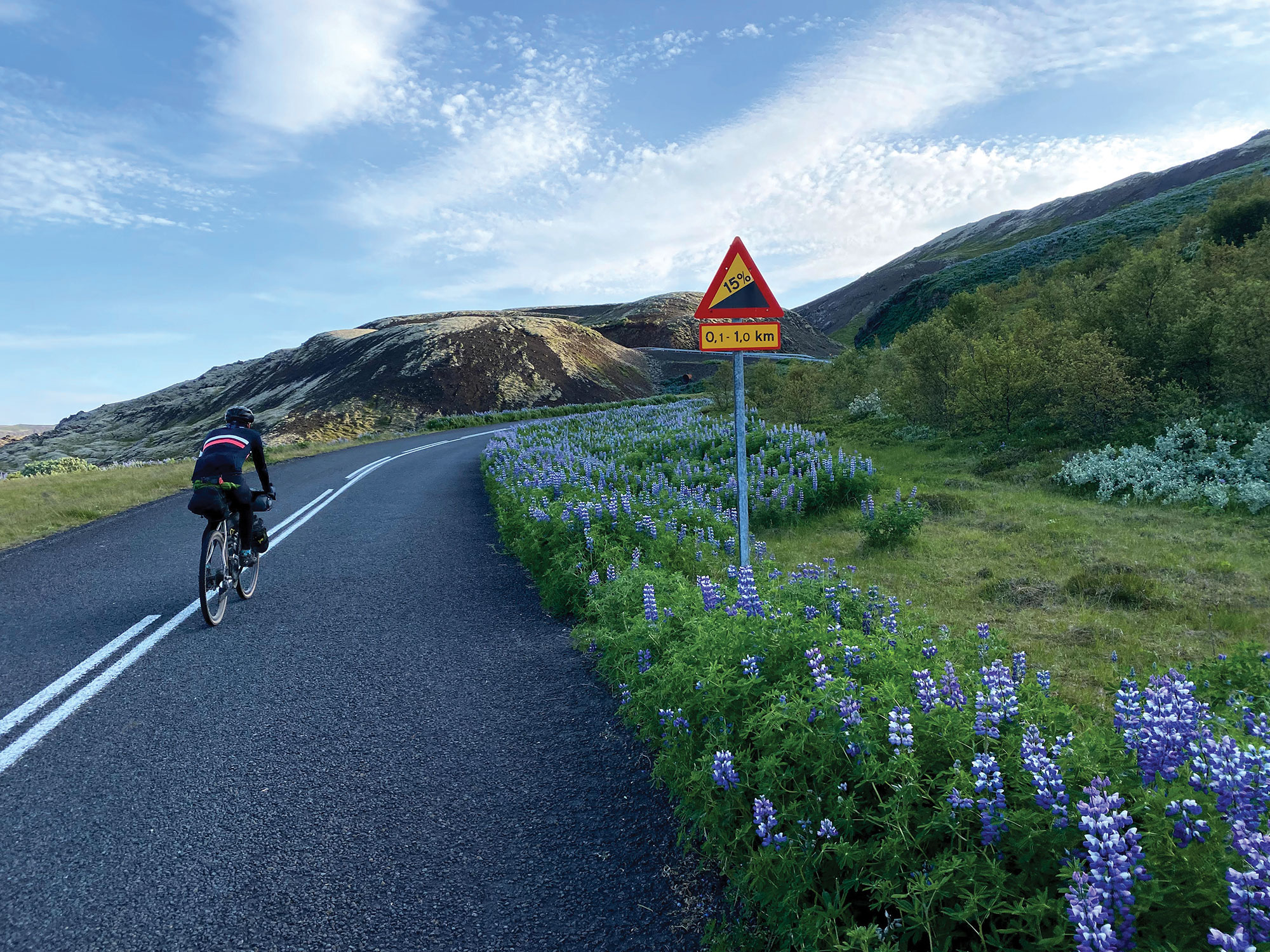
Avoiding the Ring Road meant hours of reading maps and websites, conversing with locals, and relying on our intuition and curiosity. But it was worth it. In the island’s remote northeast, for example, we climbed to Hellisheiði eystri, a mountain road 2,112 feet above sea level. The 15 switchbacks on the northern approach are one of Iceland’s steepest climbs, making it an easy target. Then at mile 1,280 and Day 13 of our trip, we hauled our 47-pound bikes into a vicious 30 mph wind to ascend Nesjavallavegur, a two-mile climb with several 20 percent pitches. We crawled along this fabulous road, surrounded by clumps of lupine and accompanied by a snaking geothermal pipeline transporting hot volcanic water to a distant power plant, and the winds never relented. Nor did we.
I would be lying if I told you there was no discomfort during the trip, but Matt and I always reminded each other that we did this by choice. Sure, it might make for a better story if it seemed like we were suffering. There’d be more tension, more turmoil, and more mystery — just like the best novels. But our intentions had nothing to do with hardship or deprivation; those were merely side effects. We were simply grateful to be able to ride on our own terms.
After summiting Nesjavallavegur, we dropped into a sunlit bowl of rock, through a series of switchbacks seemingly transported straight from the Pyrenees. We descended into a bank of clouds, still accompanied by the pipeline. As visibility vanished, it was the only thing we would see for miles in the eerie stillness.
Iceland
GETTING THERE
Flying to Iceland from North America has become increasingly easy. Icelandair serves many major U.S. cities with direct flights to Keflavík airport, outside of Reykjavík. From there, it is possible to build your bike at the airport or take a shuttle bus into the city. There are even companies that now provide bike-case pickup from the airport or at a depot near Reykjavík.
WHERE TO STAY
Despite what you may have heard, you cannot camp just anywhere in Iceland. Generally, if there is an established campground nearby, you’re encouraged to use it and pay for a site, and private property is just that: private. That said, attitudes to wild campers are typically more accepting and more welcoming than in the U.S., as long as you don’t spoil a place and you ask permission where necessary. Otherwise, guesthouses, Airbnbs, hostels, and hotels dot the country, and prices can vary from modest to exorbitant. Consider booking ahead during the high season, which runs from June through August, to secure the lodging you want at a good price.
FOOD
In certain areas of the country — the west and the south, in particular — restaurants and markets are readily available. However, when you travel to the east, north, or into the remote Westfjords region, sustenance is far more spread out and you’ll need to plan where and when to eat. You may need to fill your bags and panniers in order to get to the next village. Beware that food is expensive in Iceland, so consider cooking meals at camp. Many, but not all, campgrounds offer kitchens filled with pots and utensils for public use. In terms of the fare itself, there are great traditional seafood dishes and many hamburger joints (Icelanders seem to love their hamburgers). In more remote areas, expect to refuel on gas station food.
WEATHER
In a word, Iceland is raw. In summer, the weather can be everything from 70°F and sunny to 40°F, raining, and blowing a gale. The wind is a consistent companion, and it can be ferocious at times. June through September is the heart of the warm season, though the shoulder seasons bring their own perks. The daytime will be incredibly long in June and into July, which allows you to ride seemingly forever.
WHAT BIKE TO RIDE
If you plan to ride gravel roads in the rugged interior, bring a minimum of 42mm tires with a chunkier tread (the bigger the better). However, many dirt roads closer to the coast are far less rough — some are even glassy smooth — and an allroad or gravel bike with a 38mm tire would do just fine. There aren’t many bike shops or places to perform repairs outside of Reykjavík. Bring every tool you would need to repair your bike, including a chain tool, extra quick links, zip ties, tubes, sealant, and plugs, and know how to use them.
Chris Case is a journalist, book author, and adventure cyclist who runs the guiding company Alter Exploration.