
Heinz Stücke: The Man Who Put the World Under His Wheels

This story originally appeared in the February 2020 issue of Adventure Cyclist magazine. Heinz Stücke passed away on July 22, 2026. He was 86.
After half a century of vagrancy and nearly 650,000 kilometers, the legendary German touring cyclist Heinz Stücke put down his bike. He now dreams of sorting and exposing his memories and his 100,000 slides.
For Stücke, life is only bearable if it is crossed by bicycle. He thinks his future is behind him. Since finally getting off his bike in May 2014, he is dedicated to sorting his slides in Hövelhof, the small German city where he was born on January 11, 1940.
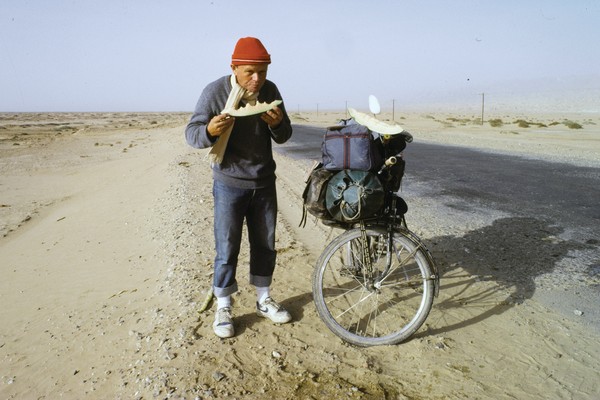
Stücke is from the old school, more familiar with tarmac than cyberspace. As if he still lived in the ’60s, Stücke is a man of oral tradition who reads little, devours maps with passion, and seldom divests himself of his portable radio, a sacred relic of the predigital era.
A Stakhanovite of the pedals, neither a visionary nor a rebel, Stücke became a collector of countries and created a legend from his perpetual exile and whispered rumors. Athlete out of the ordinary? Bike freak? Record holder? Sportsman emeritus? Vélosophe? Poet? Adventurer? Steppenwolf? But no, this unique, self-made man, who one would imagine as an old sage removed from the simple worries of daily life, remains paradoxically down to earth.

I found him in his bungalow, a house made available by the municipality, which wants to stake out a place on the national map through its native son. This, despite the fact that the inhabitants of Hövelhof don’t fully grasp the breadth of Stücke’s experience and photo archive of a disappearing world.
Exempt from taxes until now, the former bikepacker long absent from this community lives modestly by continuing to apply his tried and tested method on the razor’s edge: improvisation, instinct, the unraveling. Here and there he is the guest of honor for a travel event or festival. Over time, he has also woven a constellation of angels, guardians, and spontaneous benefactors. Stücke is generous with his time, even if, as he speaks, one could fear his anger. He talks about the world with an inexhaustible fountain of words.
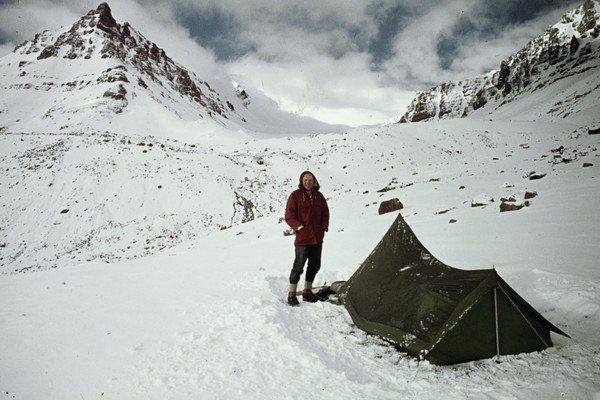
This old man of the road limps now (getting on or off a bike has become impossible), but he refuses inevitable operations, for example, on his cataracts. As he evokes his memories, his eyes light up like his illuminated globe that sits prominently on his desk. Listening to Stücke is like accessing a world in slow motion, far from fashion, without a mobile phone or computer, freeing speech. The walls of his home struggle to hold memorabilia from his journeys. This marathoner lists extraordinary figures: 21 passports, 18,000 pages of logbooks, and more than a thousand border crossings, including 96 in France alone. “I have five years before me to sort all that,” he said.
The prospect of opening this locus of memory — a real Pandora’s box — would intimidate some. Not this madman of the pedal, a craftsman as well as a meticulous archivist of his own life. Oscillating dangerously between storyteller and counter, he dreams of a bank of images in his name that will make him live forever. The documentary The Man Who Wanted to See It All by Spanish director Albert Albacete should be released at the time of this writing.
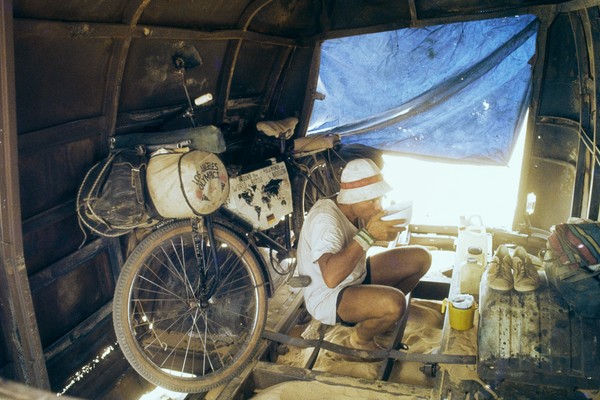
Stücke’s mother, who lost several children at birth, was always at his side. He does not have a close relationship with his two sisters, Clara, 78, and Maria, 80. Their children live in the area, but no member of his family is really interested in his tireless wanderings.

In 1951, like millions of Germans, Stücke learned of the departure of Heinz Helfgen, a compatriot, sportsman, and journalist. He left Düsseldorf on September 3, 1951, with DM 3.80 in his pocket for a world tour by bike. He would not return until the autumn of 1953. His book, Ich Radle um die Welt, was a bestseller with more than 800,000 copies sold, a success unmatched in the field of bicycle travel literature. For more than four years, the national radio broadcast twice a week on his trip. Stücke was 11 years old, and this adventure was impressed upon him forever.
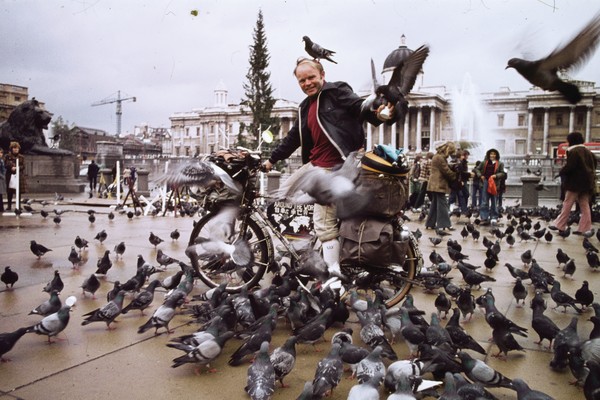
Over the years, his endless journey has turned into a personal arrangement with life. To the question of love, he responds in an ambiguous way: “You cannot live with or without a woman.”
An English caricaturist portrayed him sleeping with his bicycle under a duvet, asking the essential question: and love? Let’s talk clearly, between distance and spiritual elevation, how is the life of a man measured? Unlike a bicycle, “the man wants to leave a trace: go to heaven, give birth to a child, I would like to leave an original book.” Literal translation, see literary: “from the universe of the saddle to the universal.”

Passionate “cyclonaut” turned lecturer, journalist, and writer, Claude Marthaler spent over 16 years traveling the planet by bike, including seven years on a world tour (1994–2001, 75,807 miles, 60 countries). His childhood passion for the bicycle, which also became his livelihood, is now intertwined like the two wheels on the frame of his bicycle. His dream is to see one of his 10 books translated into English. Learn more at claudemarthaler.ch